Welcome Guest. | Log In | Register | Membership Benefits

Wardriving Evolves Into Warflying

Researchers release specs for a DIY radio-controlled plane that hacks systems by air

Aug 04, 2011 | 01:48 PM | 

By Ericka Chickowski, Contributing Editor
Dark Reading


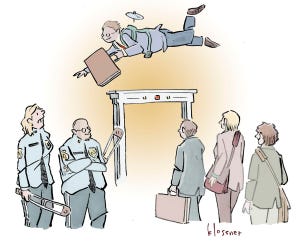
BLACK HAT USA 2011 -- Las Vegas -- Yesterday at Black Hat, two security researchers demonstrated how a radio-controlled model airplane outfitted with a computer and 4G connectivity could be used to create a nearly undetectable aerial hacking device that could perpetrate aerial attacks on targets otherwise unreachable by land.

Created completely with off-the-shelf equipment and open-source software -- and with a budget of only about $6,100 -- the demo plane they brought on stage with them was capable of wireless network sniffing and cracking, cell tower spoofing, cell phone tracking and call interception, data exfiltration, and video surveillance.

Click here for more of Dark Reading's Black Hat articles.

"There is some really evil stuff you can do from the sky," said Mike Tassey, who together with Richard Perkins spent more than 1,300 hours building, testing, and refining the device they call the Wireless Aerial Surveillance Platform (WASP).

Built on top of a surplus Army target drone Perkins had sitting in his basement, the device has been equipped with multiple wireless antennae and a microcomputer loaded with GPS, wireless sniffing tools, and the Backtrack 5 penetration testing toolkit. The 14-pound, 6-foot-long plane connects through a 4G dongle with a small base station that controls it using Google Earth and an open-source autopilot software solution. The base station streams data gathered by the plane and sends it over a VPN connection to a more robust back-end PC, which can take care of the heavy-lifting, such as crunching through large dictionaries to perform brute-force attacks. The Internet connectivity would make it possible to also crowdsource data to multiple hackers with different skill sets if a project needed the manpower.

The plane itself is powered off of an electric engine that is hard to detect by ear once it is as close as 50 feet away. Though FAA regulations prohibit flight of such devices from going above 400 feet, the drone itself would be capable of going well above 20,000 feet in altitude.

Perkins and Tassey said a device such as the one they developed could potentially be used for a number of nefarious reasons beyond run-of-the-mill hacking, including drug trafficking and terrorism. On the plus side, such drones could also be used by forces of good, including for search and rescue, military and law enforcement operations, and even to provide emergency cellular service in disaster zones. Whether built for good or bad, the design is not complicated, they said.

"You don't need a Ph.D. from MIT to do this," Perkins said.

Unfortunately, both presenters said they couldn't yet think of a good way to protect against a WASP-like attack. Not even missiles would work against these drones because they don't put out the kind of heat or radar signatures necessary for missiles to track and destroy them.

"So how do you defend against this? I don't know. That's what you guys are for. We need the right people to start thinking about this. How would you defend against something like this?" Perkins said. "Because if we thought of it, someone else has, too. They're just not telling you about it."

Have a comment on this story? Please click "Discuss" below. If you'd like to contact Dark Reading's editors directly, send us a message.


Currently we allow the following HTML tags in comments:

Single tags

These tags can be used alone and don't need an ending tag.

<br> Defines a single line break

<hr> Defines a horizontal line

Matching tags

These require an ending tag - e.g. <i>italic text</i>

<a> Defines an anchor

<b> Defines bold text

<big> Defines big text

<blockquote> Defines a long quotation

<caption> Defines a table caption

<cite> Defines a citation

<code> Defines computer code text

<em> Defines emphasized text

<fieldset> Defines a border around elements in a form

<h1> This is heading 1

<h2> This is heading 2

<h3> This is heading 3

<h4> This is heading 4

<h5> This is heading 5

<h6> This is heading 6

<i> Defines italic text

<p> Defines a paragraph

<pre> Defines preformatted text

<q> Defines a short quotation

<samp> Defines sample computer code text

<small> Defines small text

<span> Defines a section in a document

<s> Defines strikethrough text

<strike> Defines strikethrough text

<strong> Defines strong text

<sub> Defines subscripted text

<sup> Defines superscripted text

<u> Defines underlined text

Dark Reading encourages readers to engage in spirited, healthy debate, including taking us to task. However, Dark Reading moderates all comments posted to our site, and reserves the right to modify or remove any content that it determines to be derogatory, offensive, inflammatory, vulgar, irrelevant/off-topic, racist or obvious marketing/SPAM. Dark Reading further reserves the right to disable the profile of any commenter participating in said activities.

Disqus Tips To upload an avatar photo, first complete your Disqus profile. | View the list of supported HTML tags you can use to style comments. | Please read our commenting policy.
Subscribe to RSS


Featured Webcasts
Featured Whitepapers
Featured Reports
Bugs
ENTERPRISE VULNERABILITIES
Vulnerability:ssl-vpn end-point interrogator/installer activex control
Published:2010-11-03
Severity:High
Description:Stack-based buffer overflow in SonicWALL SSL-VPN End-Point Interrogator/Installer ActiveX control (Aventail.EPInstaller) before 10.5.2 and 10.0.5 hotfix 3 allows remote attackers to execute arbitrary code via long (1) CabURL and (2) Location arguments to the Install3rdPartyComponent method.
Vulnerability:gvim
Published:2010-11-03
Severity:High
Description:Untrusted search path vulnerability in VIM Development Group GVim before 7.3.034, and possibly other versions before 7.3.46, allows local users, and possibly remote attackers, to execute arbitrary code and conduct DLL hijacking attacks via a Trojan horse User32.dll or other DLL that is located in the same folder as a .TXT file. NOTE: some of these details are obtained from third party information.
Vulnerability:cforms
Published:2010-11-03
Severity:Medium
Description:Multiple cross-site scripting (XSS) vulnerabilities in wp-content/plugins/cforms/lib_ajax.php in cforms WordPress plugin 11.5 allow remote attackers to inject arbitrary web script or HTML via the (1) rs and (2) rsargs[] parameters.
Vulnerability:links, wsn links, wsn links
Published:2010-11-03
Severity:High
Description:Multiple SQL injection vulnerabilities in search.php in WSN Links 5.0.x before 5.0.81, 5.1.x before 5.1.51, and 6.0.x before 6.0.1 allow remote attackers to execute arbitrary SQL commands via the (1) namecondition or (2) namesearch parameter.
Vulnerability:deluxebb
Published:2010-11-03
Severity:Medium
Description:SQL injection vulnerability in misc.php in DeluxeBB 1.3, and possibly earlier, when magic_quotes_gpc is disabled, allows remote attackers to execute arbitrary SQL commands via the xthedateformat parameter in a register action, a different vector than CVE-2005-2989, CVE-2006-2503, and CVE-2009-1033.


Briefing Centers
POWERFUL INFORMATION
AT YOUR FINGERTIPS
(SPONSORED LINKS)