![]() |
Data security and privacy: A holistic approach Download here |
Forrester recently published a research report, titled "Data Virtualization Reaches Critical Mass," to communicate data management trends -- and it has some important implications for data security.
I'll say up-front that "data virtualization" is a terrible name for the market being described, that database "consolidation" is not a trend I am seeing, and extraction-transformation-load (ETL) is not causing any more data quality problems than it did a decade ago. Still, the report contains some good information, and I generally agree with many of the conclusions about where the market is heading.
There are critical changes coming to the way we consume data. Some of this is driven by the way we collect information, and some is driven by changes to the infrastructure (virtualization and cloud technologies). I think the key insight here is that data federation capabilities are evolving to meet demand, and that data management tools will need to change as well. In this post, I want to discuss what this means in terms of data security.
But first, let's get some terminology straight because there are a couple definitions floating around: This market is actually data federation. The data is not virtual -- it's real. We are not pretending to retain the original data format; rather, we are combining all formats and hiding the details from the consumer of information. The data can be stored, or it can be dynamically acquired. The source and format of the data is variable; the value proposition is to be able to bring disparate systems together and consume data regardless of the underlying format. Virtualization is a sexier term than federation, which is why vendors would choose to use it, but federation is what's going on here.
What does this have to do with database security? The trend is this: The concept of a "database" is reverting to the nonrelational meaning of any container of data. Applications no longer care whether data comes from a relational database, a nonrelational database, the results of a BI system query, Web site scraping, a Google search, an XML stream, the current geolocations of mobile users, or pretty much any data source. The real trend is for applications to be able to access and analyze different sources regardless of the form data takes.
What's important here is to understand that federated data systems take care of the mapping of these data sources seamlessly for you, behind the scenes. And it's done by having access to the metadata that interprets the data structure and type on-the-fly, so applications can use data regardless of source. The technology works dynamically like a database abstraction layer (e.g., Hibernate) or as a data transformation function (i.e., ETL). Note that today there are not many providers, with only a handful of data integration providers, relational database vendors, platform-as-a-service vendors, and custom applications.

For those of you who are familiar with SQL injection attacks, you know that they are possible when we don't validate input variables. One of the issues with federating data from multiple sources is validating the application that sends us data, as well as the data itself. Given that speed of processing is the typical measure of success, data validation capabilities are underserved. Much like drive-by malware, if you don't validate data coming from different sources, you're likely to receive bad data or malicious content. XML schema and data validation tools deal with complex data types. The ability to "mask" data streams quickly becomes a critical requirement -- both for hiding sensitive data, as well as filtering bad content -- when moving data between production platforms, or from production to nonsecured test environments. Before data is exposed to federation, you need to know whether there is sensitive information present and what to do with it.

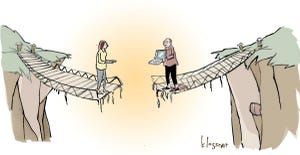

As the Forrester report indicates, datadiscovery tools will need to adapt to deal with different data sources. I anticipate that database activity monitoring will need to include both file activity monitoring, as well as DLP-like analysis capabilities in this type of environment.
Undoubtedly, this change is coming, but it creates new security challenges. The producer-consumer data model creates new trust issues, and existing data and database security tools that rely on format will need to evolve. Relational database vendors and masking vendors both offer tools in existing products to help, but they will need to evolve, as well.
Adrian Lane is an analyst/CTO with Securosis LLC, an independent security consulting practice. Special to Dark Reading.
| To upload an avatar photo, first complete your Disqus profile. | View the list of supported HTML tags you can use to style comments. | Please read our commenting policy. |
Securing The Data Warehouse
Many enterprises are building data warehouses to centralize the ever-increasing information flowing through their organizations into useful repositories. This makes good business sense, but it opens up a slew of concerns from a security standpoint. IT professionals can apply many of the same security best practices used with databases, but there are new lessons to be learned as well.
Defend Your Data From Malicious Insiders
The biggest threat to your company?s most sensitive data may be the employee who has legitimate access to corporate databases but less-than-legitimate intentions. And while the incidence of insider data breaches has decreased, external attacks often imitate them--and do serious damage. Follow our advice to mitigate the risk.
Ensuring Secure Database Access
Role-based access control based on least user privilege is one of the most effective ways to prevent the compromise of corporate data. But proper provisioning is a growing challenging, due to the proliferation of "big data," NoSQLdatabases, and cloud-based data storage.
Other reports from the Database Security Tech Center:
| Sponsored by: |
Establishing a Strategy for Database Security is No Longer Optional
As databases continue to grow in size, complexity and importance, enterprises struggle to identify the most appropriate controls regarding their use and misuse. The report identifies best practices, including: Implementing database activity monitoring to mitigate the high levels of risk from database vulnerabilities, and address audit findings in areas such as database segregation of duties and change management; using data security measures, such as data masking and data encryption; and monitoring privileged-user access and access to critical data.
Database Activity Monitoring Is Evolving Into Database Audit and Protection
In this report, Gartner writes that "Database audit and protection (DAP) represents an evolutionary advance in database activity monitoring tools." DAP suites provide comprehensive, cross-platform support in heterogeneous database environments to protect sensitive data from inappropriate use. Organizations are increasingly concerned with optimizing database security and mitigating risks associated with database vulnerabilities.
Protecting Against Database Attacks and Insider Threats: Top 5 Scenarios
Data security presents a multi-dimensional challenge in today's complex IT environment. Multiple access paths and permission levels have resulted in a broad array of security threats and vulnerabilities. We invite you to read this new eBook: "Protecting against database attacks and insider threats" to learn the top five scenarios and essential best practices for preventing database attacks and insider threats.
Demo: Distributed Database Security with Real-time Monitoring and Audit Protection
Organizations across the globe continue to experience compromised data caused by malicious attacks, web application vulnerabilities or unauthorized changes. View this demo and learn how IBM InfoSphere Guardium? database activity monitoring can help protect your sensitive data in distributed DBMS environments with a holistic approach to data security and compliance.
Look Beyond Native Database Auditing To Improve Security, Audit Visibility, And Real-Time Protection
Today's attacks on enterprise databases are more sophisticated than ever, and they occur so fast that it's often difficult to stop them in real time. Despite significant efforts to protect enterprise databases, the number of records breached has grown each year - due to all types of internal and external attacks and violations of corporate policy.
MORE NEWSFEED >>>